Comments on Changes to Implement the Patent Search Fee Refund Provisions of the Consolidated Appropriations Act, 2005 (August 2005)
Posted by Douglas Sorocco at August 31, 2005 09:38 PM
As of August 25, 2005, the organizations and persons listed below have submitted comments in response to the proposed rule Changes to Implement the Patent Search Fee Refund Provisions of the Consolidated Appropriations Act, 2005, published in the Federal Register at 70 Fed. Reg. 35571 [PDF] (June 21, 2005), and in the Official Gazette at 1296 Off. Gaz. Pat. Office 69 (July 12, 2005). It is hoped that the public will review this list to determine if it is complete. If any person or organization has submitted comments but is not included in this listing, please submit the comment by electronic mail message at AB79.Comments@uspto.gov, or contact Robert W. Bahr by telephone at (571) 272-8800.
Please note that the following documents are provided as submitted by persons and organizations but may contain spelling corrections, artifacts of scanning, OCR, or document format conversion.
A. Intellectual Property Organizations
1. American Intellectual Property Law Association (AIPLA) [PDF]
B. Law Firms
1. Oliff & Berridge, PLC [PDF]
C. Individuals
1. Apley, Dick [PDF]
2. Usher, Robert W.J. [PDF]
Some contents linked to on this page require a plug-in for PDF files.


Reciprocal Access to and Usage of Documents in Application Files of Trilateral Offices [signed 29August2005]
.pdf of preog notice available here: http://www.uspto.gov/web/offices/pac/dapp/opla/preognotice/tda.pdf
USPTO Announces Seminars for Texas and Florida Businesses on Protecting Their Intellectual Property from Theft
Posted by Stephen M. Nipper at August 30, 2005 10:19 AM
USPTO Announces Seminars for Texas and Florida Businesses on Protecting Their Intellectual Property from Theft
Part of federal governmentâs Strategy Targeting Organized Piracy (STOP) efforts to combat intellectual property theft in China and other high-risk nations
The USPTO will open a two-day conference for small businesses on âIntellectual Property in the Global Marketplaceâ on Monday, September 12, 2005, at the Hyatt Regency, 208 Barton Springs Road in Austin, TX and on Monday, September 26 at the Marriott Miami, 1201 NW LeJeune Road in Miami, FL. These two events, sponsored by the United States Patent and Trademark Office (USPTO), are part of STOP (Strategy Targeting Organized Piracy) a major federal government effort to protect American businesses from falling victim to intellectual property theft â both domestically and abroad.
In today's global marketplace, American products and branding can be stolen by an individual or a business halfway around the world without the rightful owner even being aware of it. Small businesses are particularly at risk because they may lack the knowledge and expertise to effectively combat such theft. In recognition of this need, USPTO is hosting a series of seminars across the country to help educate American small businesses about the realities of piracy and counterfeiting and steps they can take to protect themselves.
During the two-day seminars, patent, trademark and copyright experts and lawyers from the USPTO will provide small- and medium-sized businesses, entrepreneurs, and independent inventors interested in manufacturing or selling their products abroad with specific details and useful tips about protecting and enforcing their intellectual property rights in the United States and around the world. Deputy Under Secretary of Commerce for Intellectual Property Steve Pinkos will kick off the seminar in Austin.
There is no charge for the conference, but seating is limited. For more information and to register for either the Austin or Miami conference, select one of the follwing links:
Austin, TX â September 12-13
Miami, FL â September 26-27
Announcement Regarding New Trademark Official Gazette Search Line In TESS, The Trademark Electronic Search System
Posted by J Matthew Buchanan at August 28, 2005 12:15 AM
The United States Patent and Trademark Office (USPTO) is pleased to announce that the on-line Trademark Electronic Search System, TESS, now features a new Trademark Official Gazette (TMOG) “search line.” By entering the publication date of a particular TMOG into the new search line, users can generate a list of all marks published for opposition in that TMOG, or a list of all new registrations published in that TMOG.
Additionally, users can refine those lists so that they include only marks published in a particular TMOG that have particular characteristics. For example, users could generate a list of all the marks published for opposition in the TMOG of August 2, 2005 that identify goods classified in international class 9. To do so, users would enter the following into TESS:
1. In the “OG Date” line, enter 20050802;
2. In the corresponding field line, select “publish for opposition date” from the pull-down menu;
3. In the operator field, select “and” from the pull-down menu;
4. In the “search term” line, enter 009; and
5. In the corresponding field, select “international class” from the pull-down menu.
Please note that although the TMOG search line is specifically designed for searching particular issues of the TMOG, other search lines in TESS can be used to conduct more complex searches of individual TMOGs.
Please also note that whereas the TMOG is published each Tuesday, the TESS records for particular marks generally do not include the TMOG publication date for the mark until the following Wednesday. Hence, a search of a particular TMOG issue that is conducted on the day that issue is published may not yield any results.
Announcement Regarding Upcoming Issues Of The Trademark Official Gazette
Posted by J Matthew Buchanan at August 26, 2005 11:34 PM
The United States Patent and Trademark Office wishes to advise the public that the issues of the Trademark Official Gazette (TMOG) that will be published during the months of August, September, and October, as well as early November, will feature an unusually large number of marks. While the USPTO cannot predict precisely how many marks will appear in each of these TMOG issues, the USPTO expects that the different issues will include a minimum of approximately 6,000 marks, and as many as approximately 10,000 marks. These large volumes are the result of a processing backlog that the USPTO accumulated when it moved its offices to its current facility in Alexandria, Virginia. The USPTO deeply regrets any inconvenience
The USPTO notes that the on-line Trademark Electronic Search System (TESS) can be used to search an individual volume or volumes of the TMOG. For example, parties can conduct a search that will generate a list of all marks published for opposition in a particular TMOG volume that include a particular word or a particular design, or that are owned by particular parties, or whose associated goods or services are classified in a particular class.
Examples of possible TESS searches of individual TMOG volumes follow. Please note that whereas the TMOG is published each Tuesday, the TESS records for particular marks generally do not include the TMOG publication date for the mark until the following Wednesday. Hence, a search of a particular TMOG issue that is conducted on the day that issue is published may not yield any results.
1. Example #1. Search for all marks published for opposition in the TMOG of August 9, 2005 that are comprised of or feature the term DOG, using the "structured form search" option.
1. Enter 20050809 as the first search term;
2. Select "Published for Opposition Date" as the field within which the term identified in 1. a. above should be searched for;
3. Select AND as the Boolean operator;
4. Enter *DOG* as the second search term; and
5. Select "Basic Index" as the field within which the term identified in 1. b. above should be searched.
2. Example #2: Search for all marks published for opposition in the TMOG of August 2, 2005 that feature a design of either a dog or the head of a dog, using the "free form search" option.
1. Enter the following into the search field: 20050802[po] and (030108 OR 030116)[DC]
3. Example #3: Conduct a sequence of searches, each of which builds on the previous search, using the "free form" search option.
1. Generate a list of all marks published for opposition in the TMOG of August 2, 2005 by entering the following in the search field: 20050802[po]
2. After generating the list referred to in 3 a. above, generate a list of all marks published for opposition in the TMOG of August 2, 2005 that identify goods classified in international class 9 by entering the following in the search field: s1 and 009[ic]
3. After generating the list referred to in 3 b. above, generate a list of all marks published for opposition in the TMOG of August 2, 2005 that identify goods classified in international class 9, AND that include the word "software" in the identification of goods, by entering the following in the search field: s2 software[gs]
Notice of Availability of and Request for Comments on Green Paper Concerning Restriction Practice
Posted by J Matthew Buchanan at August 21, 2005 11:14 PM
http://www.uspto.gov/web/offices/com/sol/notices/70fr45370.pdf
Requirements To Receive a Reduced Fee for Filing an Application Through the Trademark Electronic Application System
http://www.uspto.gov/web/offices/com/sol/notices/70fr38768.pdf
Changes To Implement the Patent Search Fee Refund Provisions of the Consolidated Appropriations Act, 2005
http://www.uspto.gov/web/offices/com/sol/notices/70fr35571.pdf
Acceptance, Processing, Use and Dissemination of Chemical and Three-Dimensional Biological Structural Data in Electronic Format
http://www.uspto.gov/web/offices/com/sol/notices/70fr35573.pdf
Revision of Search and Examination Fees for Patent Cooperation Treaty Applications Entering the National Stage in the United States
http://www.uspto.gov/web/offices/com/sol/notices/70fr35375.pdf
U.S. INTELLECTUAL PROPERTY CHIEF SALUTES AMERICAâS INDEPENDENT INVENTORS
Alexandria, VA – U. S. Under Secretary of Commerce for Intellectual Property Jon Dudas today asked independent inventors to protect American ingenuity by safeguarding their inventions from intellectual property theft. Small businesses—such as independent inventors—are often at particular risk for IP theft, a growing problem around the world. Dudas urged attendees at the 10th annual Independent Inventor’s Conference to make patent, trademark and copyright protection a core part of their business strategy.
“The strength of our nation’s economy rests on the ingenuity of American inventors,” Dudas said. “In the 21st century, securing protection for your inventions is almost as important as the invention itself.”
“As inventors turn their ideas and discoveries into viable, marketable products, it is critically important for them to get the protection they need to safeguard their inventions and help protect our overall economy,” he continued.
From Willis Carrier’s air conditioning to Clarence Birdseye’s frozen food technology, independent inventors have shaped the American economy throughout history. More than 200 independent inventors at the conference heard from Al Langer, the engineer on the medical team that invented the first automatic implantable cardioverter defibrillator, a life-saving device. Langer’s device has revolutionized the way doctors treat heart patients, and his success as an inventor and entrepreneur provided valuable insights for conference attendees.
“Throughout history, inventors have helped people discover new worlds, build communities, and cure sickness and disease, said Deputy Under Secretary of Commerce for Intellectual Property Steve Pinkos. “This conference celebrates all that inventors have accomplished in our nation’s history, and will create in the future.”
The U.S. continues to be the driver of ingenuity around the world, evidenced by the surge in patent, trademark and copyright applications from inventors and the resulting patents issued by USPTO. In 2004, the USPTO received more than 376,000 applications for patents, and patent applications have more than doubled since 1992. In fact, the USPTO issued more patents in 2004 than it did during its first 40 years.
Dudas and Pinkos also used their remarks to talk to inventors about what the U.S. government is doing to combat intellectual property theft. While they pointed out that intellectual property theft poses a threat to all American businesses, both officials said that most small businesses and independent inventors are particularly at risk because they often lack the knowledge and expertise to effectively combat it. To address this, Dudas said that the USPTO is hosting the Independent Inventor’s Conference—which is co-sponsored by the National Inventors’ Hall of Fame—and a series of seminars across the country to help educate American inventors and small businesses about the realities of piracy and counterfeiting. During these events, intellectual property experts from the agency will provide attendees with details and useful tips about protecting and enforcing their intellectual property rights in the United States and around the world.
The USPTO is also currently conducting a nationwide awareness campaign that is providing information to small businesses about when to file for intellectual property protection, what type of protection to file for, where to file and how to go about it. The effort features outreach targeting industry sectors especially at risk of intellectual property theft, a Web site specifically designed to address the needs of small businesses, and informational materials informing small businesses about the problem and steps they can take to mitigate it. Materials and other information about the awareness campaign are available at www.stopfakes.gov/smallbusiness.
For more information about the U.S. Patent and Trademark Office’s effort to educate American small businesses about intellectual property rights, visit www.stopfake.gov/smallbusiness or www.uspto.gov.
# # #
Bush Administration Official Reminds Arizona Children that U.S. Intellectual Property Protection Begins With Them
U. S. Under Secretary of Commerce for Intellectual Property Jon Dudas on Monday asked elementary students attending Camp Invention to help combat piracy, counterfeiting and copyright violations by refraining from illegally copying and downloading music, movies, software, and computer games. Dudas reminded the children that copying or downloading others’ property without their permission is a crime, and that this crime has real economic consequences for our economy. Dudas addressed eighty 2nd – 6th graders participating in Camp Invention at Lone Mountain Elementary School in Cave Creek, Arizona.
“Illegally copying computer games, DVDs and other products is just as wrong as stealing these items from the store,” Dudas said. “Copying and downloading Star Wars video games and movies is not okay—it’s breaking the law because it is stealing someone else’s property. It’s up to all of us to show respect for others’ property, whether it’s our next- door neighbor, our classmate or a company that’s far away.”
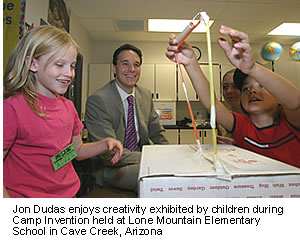 Camp Invention, cosponsored by the USPTO and the National Inventors Hall of Fame, is a nationwide educational outreach program designed to give children in grades 2-6 an alternative to traditional classroom experiences. Camp Invention's purpose is to stimulate the imaginations of America's next generation of inventors, and the weeklong day camp builds on a child's innate curiosity and intuition about the way things work. Emphasis is placed on the creative process that leads children to problem solving, discovery and invention.
In sessions such as “I Can Invent,” campers take apart old appliances and use the parts to create their own inventions. In another session, they simulate the process of applying for a patent. The thought-provoking learning experience teaches young people the importance of respecting people’s intellectual property just as they would any tangible property, as well as how the patent and trademark system works to support our economy.
Dudas also used his remarks to educate the students about what constitutes intellectual property, explaining that the term ‘intellectual property’ can be used to describe many products—a car, a medicine, a toy, a video game or a CD—as long as the product began as an idea. Dudas talked about patents, trademarks and copyrights and their importance to our nation’s economy and our daily lives. “The jobs of the future depend on our nation’s ability to continue to generate new inventions and innovations and to stay one step ahead of other nations in today’s global marketplace,” he said.
Dudas’ visit to Camp Invention was part of his visit to Phoenix, where he and the USPTO hosted a two-day “Conference on the Global Intellectual Property Marketplace” on July 18-19, 2005. The seminar was the second in a series that the USPTO is hosting across the county to help educate American small businesses about the realities of piracy and counterfeiting.
(20JUL2005)
Government Seeks Help from Arizonal Schoolchildren in Fight against Illegal Downloading and Copying of Music, Movies, Video Games
Government Seeks Help from Arizonal Schoolchildren in Fight against Illegal Downloading and Copying of Music, Movies, Video Games
Message to be delivered during meeting with next generation of inventors, entrepreneurs in Cave Creek
Washington, D.C. – Under Secretary of Commerce for Intellectual Property Jon Dudas will speak with young innovators attending Camp Invention at Lone Mountain Elementary School in Cave Creek, Arizona on July 19, 2005. Under Secretary Dudas will speak to students on the importance of intellectual property rights and remind them that downloading and copying music, movies and video games without the permission of the artists’ or copyright holders’ permission is illegal—and that the government needs their help in stopping these crimes. Dudas will also talk to the children about the importance of intellectual property, describing the value of patents, copyrights and trademarks to our economy.
Camp Invention, cosponsored by the USPTO and the National Inventors Hall of Fame, is a nationwide educational outreach program designed to give children an alternative to traditional classroom experiences. The weeklong day camp emphasizes problem-solving techniques while trying to stimulate the imaginations of America’s next generation of inventors. The experience provides children with an opportunity to explore new ideas while learning the importance of the patent and trademark system in our economy.
WHO: The Honorable Jon Dudas, Under Secretary of Commerce for Intellectual Property, Director of the U.S. Patent and Trademark Office
WHAT: Discussion with elementary students attending Camp Invention
WHEN: Tuesday, July 19, 2005 10:00 a.m.
WHERE: Lone Mountain Elementary School, 5250 E. Montgomery Road, Cave Creek, Arizona 85327
WEB: Visit http://www.uspto.gov/ to learn more about the U.S. Patent and Trademark Office
U.S. GOVERNMENT URGES ARIZONA'S BUSINESSES TO PROTECT THEIR INTELLECTUAL PROPERTY FROM THEFT OVERSEAS
U.S. GOVERNMENT URGES ARIZONA'S BUSINESSES TO
PROTECT THEIR INTELLECTUAL PROPERTY FROM THEFT OVERSEAS
Small Businesses Especially At Risk, Says U.S. Patent & Trademark Office
Phoenix, Arizona – U. S. Under Secretary of Commerce for Intellectual Property Jon Dudas today warned an audience of Arizona small-businessmen and –women that they are increasingly at risk of overseas intellectual property theft -- even if they do not export -- and urged them to consider protective action. In his remarks before the “Conference on the Global Intellectual Property Marketplace,” sponsored by the Commerce Department’s U.S. Patent and Trademark Office (USPTO), Dudas cited Arizona’s export-dependant economy—particularly the state’s 300% increase in exports to China since 2000—as a major reason why businesses in the state should make intellectual property protection in the United States and overseas a priority business decision.
“Piracy and counterfeiting are on the rise around the world, and all American businesses--including the thousands of small businesses here in Arizona--are at risk,” Dudas said. “The U.S. Patent and Trademark Office is sponsoring seminars like this one to arm small businesses with the information they need to protect their intellectual property, in the United States as well as around the world.”
While theft of intellectual property pose a serious threat to all American businesses, small businesses are particularly at risk because they often lack the knowledge and expertise to effectively combat it. Because small businesses typically do not have personnel or maintain large operations in other countries, theft of their intellectual property overseas can go undetected.
The Phoenix seminar is the second in a series the USPTO is hosting across the country to help educate American small businesses about the realities of piracy and counterfeiting. During the two-day seminar (July 18-19, 2005) in Phoenix, intellectual property experts from the agency are providing attendees with details and useful tips about protecting and enforcing their intellectual property rights in the United States and around the world.
The Phoenix seminar represents one of the U.S. Patent and Trademark Office’s many efforts to educate small businesses about intellectual property protection. Currently, the agency is conducting a nationwide awareness campaign that is providing information to small businesses about when to file for intellectual property protection, what type of protection to file for, where to file and how to go about it. The effort features outreach targeting industry sectors especially at risk of intellectual property theft, a Web site specifically designed to address the needs of small businesses, and informational materials informing small businesses about the problem and steps they can take to mitigate it. Materials and other information about the awareness campaign are available at www.stopfakes.gov/smallbusiness.
The campaign, in turn, is part of a much larger USPTO and federal government effort. The Strategy Targeting Organized Piracy (STOP!) initiative, also directed at small businesses, aims to combat criminal networks that traffic in fakes, stop trade in pirated and counterfeit goods at America’s borders and help small businesses secure and enforce their rights in overseas markets. As part of the initiative, the U.S. Patent and Trademark Office maintains a toll-free telephone hotline, 1-866-999-HALT, that helps businesses leverage the resources of the U.S. government to protect their intellectual property rights.
For more information about the U.S. Patent and Trademark Office’s effort to educate American businesses about intellectual property rights, visit www.uspto.gov.
# # #
USPTO Museum Opens at New Headquarters
Washington, D.C. -- U.S. Under Secretary of Commerce for Intellectual Property and Director of the United States Patent and Trademark Office (USPTO) Jon Dudas was joined today by Alexandria Mayor William D. Euille, U.S. Representatives Jim Moran and Frank Wolf, and David Fink, President and CEO of the National Inventors Hall of Fame, in a ribbon-cutting ceremony opening the agency’s new museum.
“The Patent and Trademark Office Museum is our opportunity to showcase innovation and the men and women whose creativity have helped foster a strong and prosperous America,” noted Under Secretary Dudas.
The National Inventors Hall of Fame and the exhibit design company Chermayeff & Geismar designed an exciting space in a modern aesthetic style using a rich palette of exhibit techniques—such as videos, interactives, artifacts and touch-screen technology—to feature patents, trademarks, inventors and inventions.
“The National Inventors Hall of Fame is pleased to bring the story of the USPTO to life,” said David Fink. “Through the state-of-the-art displays we’ve designed, we hope that visitors to the museum will take away an understanding of the USPTO’s rich history as well as its exciting future.”
Since the beginning of time, people have been developing better ways to do things, and for over 200 years the American patent and trademark systems have been there to protect and encourage innovation. Everyone benefits, and that story is told well in the opening exhibit, The Invention Machine: A Day in My Life.
The museum’s visitors will realize, as they view the exhibit, that they take advantage of inventions and rely on trademarks every day of their lives without ever stopping to think of their origins. Visitors will see how intellectual property is found in the routines they follow at the beginning of the day, in methods they use for travel, in medical innovations they rely upon for good health, and in the different ways they relax and play.
The museum and gift shop will open to the public on Thursday, July 14, 2005. It is located in the atrium of the Madison Building, 600 Dulany Street, Alexandria, VA, and easily accessible from the King Street and Eisenhower Avenue Metro stations. The hours will be 10:00 a.m. to 6:00 p.m., Tuesday through Friday and noon to 5:00 p.m. Saturday and Sunday; closed on Mondays and federal holidays.
# # #
USPTO REDUCES FEES FOR TRADEMARK ELECTRONIC APPLICATION FILING
The Department of Commerce’s United States Patent and Trademark Office (USPTO) announced today that beginning July 18, 2005, the agency will offer applicants for trademark registrations a new Trademark Electronic Application System (TEAS) known as TEAS Plus that will add up to considerable savings for many filers.
The fee for filing a trademark application will be reduced by $50 per class for those using TEAS Plus. Most filers seek trademark protection for more than one class of goods and services in their application. In return for paying the lower filing fee, applicants who file using TEAS Plus agree to submit complete applications electronically, and to communicate electronically only with the USPTO about the application.
"This change reflects the mandate of the President's Management Agenda for citizen-centered, results-oriented government," noted Under Secretary of Commerce of Intellectual Property and Director of the USPTO Jon Dudas. "Specifically, TEAS Plus offers applicants an opportunity to save money by filing and managing their applications electronically. We hope the TEAS Plus option will make our already popular system even more useful to the public."
Nearly 82 percent of all trademark applications filed so far this year were transmitted electronically. That represents an increase of nearly 20 percent over last year.
# # #
Lynne G. Beresford Named Commissioner for Trademarks
U.S. Secretary of Commerce Carlos M. Gutierrez has named Lynne G. Beresford to be Commissioner for Trademarks at the Commerce Department’s U.S. Patent and Trademark Office (USPTO). Beresford has been acting Commissioner for Trademarks since September 1, 2004.
In response to the appointment, Under Secretary of Commerce for Intellectual Property Jon Dudas noted, “Lynne Beresford has a track-record of excellence and achievement, both as a manager and as a trademark expert. The Secretary’s appointment ensures continuity of our successful trademark operations.”
As Commissioner for Trademarks, Beresford is responsible for the productivity and quality of the work done by more than 300 examining attorneys, paralegals and other support professionals. She also oversees budget and trademark-related information technology (IT) decisions.
Beresford began her career at the USPTO in 1979 as a trademark examining attorney. She has held a variety of management positions throughout her career, including managing attorney, trademark legal administrator, deputy commissioner for trademark examination policy, and acting deputy commissioner for trademark operations. Beresford also served as a senior attorney in the USPTO’s Office of International Relations.
In 1989 Beresford managed the computer aspects of the implementation of the Trademark Law Revision Act of 1988. She chaired every meeting of the World Intellectual Property Organization’s Standing Committee on Trademarks, Industrial Designs and Geographical Indications from its inception in 1997 until late 2001 and was instrumental in drafting the legislation to implement the Madrid Protocol and the Trademark Law Treaty.
# # #
Requirements To Receive a Reduced Fee for Filing an Application Through the Trademark Electronic Application System
http://www.uspto.gov/web/offices/com/sol/notices/70fr38768.pdf
John J. Doll Named Commissioner for Patents
U.S. Secretary of Commerce Carlos M. Gutierrez has named John J. Doll to be Commissioner for Patents at the United States Patent and Trademark Office (USPTO). Doll has been Acting Commissioner for Patents since April 2005.
In response to the appointment, Under Secretary of Commerce for Intellectual Property Jon Dudas noted, “I am pleased that the Secretary has chosen John Doll to be the Commissioner for Patents. John has excellent management skills combined with a dedication to outstanding service to the public and a focus on internal reform.”
As Commissioner for Patents, Doll is responsible for the productivity and quality of the work done by more than 4,000 patent examiners, paralegals and other support professionals, for patent examination policy, budget decisions, and for patent-related Information Technology (IT) decisions.
From January – April 2005, Doll served as the Deputy Commissioner for Patent Resources and Planning directing information processing and technology, and budget formulation and execution for patent operations. He previously served as Special Assistant to the Under Secretary. Doll was a group director from 1995-2005 in the technology center responsible for examination of biotechnology, organic chemistry, and pharmaceutical patent applications. He was an integral part of the team responsible for last year’s implementation of the Image File Wrapper (IFW), the USPTO’s electronic patent application processing system.
Doll has received numerous awards throughout his USPTO career, including the Vice Presidential Hammer Award for his work in establishing the Biotech Customer Partnership; a Department of Commerce Gold Medal for his work on the team that implemented IFW; and a Silver Medal for his work on automating patent examiner tools.
During his tenure as a group director, Doll managed the development and implementation of training materials used by patent examiners to apply the enablement provisions of the patent statute in reviewing applications. He also helped develop and implement the guidelines and training materials used by examiners evaluating patent applications for compliance with the utility and written description provisions of patent law.
Doll holds a Bachelor of Science degree from Bowling Green State University in chemistry and physics and a Master of Science degree in physical chemistry from Penn State University. He joined the USPTO in 1974.
# # #
USPTO IMPROVES PROCESS FOR REVIEWING PATENTS
The U.S. Department of Commerce’s United States Patent and Trademark Office (USPTO) has implemented new processes for handling reexamination proceedings to improve timeliness and quality. Patent reexamination is a valuable, low-cost alternative to litigation for determining the patentability of the claims in an issued patent. Requests for the USPTO to reexamine a patent can be made as long as written evidence is presented that raises a substantial new question of patentability.
“Timeliness and correctness of decisions in reexamination proceedings are important to providing certainty for all users of the patent system,” noted Under Secretary of Commerce for Intellectual Property and Director of the USPTO Jon Dudas. “We have a duty to the American public to get reexaminations right and to conduct them with dispatch so they remain an effective tool.”
The USPTO’s goal is that reexaminations that have been pending with an examiner more than two years now will be resolved by October 1, 2005. In addition, all future reexamination proceedings will be completed within a specific timeframe, which is expected to be less than two years. In March 2005 there were over 420 reexaminations that had been pending more than two years and that number would have grown to over 600 by the end of September 2005. Today, fewer than 360 cases remain, with nearly half in the final stages. To ensure the quality of these proceedings, all reexamination decisions now require a thorough review by a panel of supervisors and senior patent examiners. Reexaminations where an initial decision has been made will remain with the examiner originally assigned to the reexamination. All other reexaminations will be reassigned to a newly formed central reexamination unit.
Prior to the new initiative, reexamination cases were assigned to examiners according to technology. Under the new initiative, 20 highly skilled primary examiners who have a full understanding of reexamination practice and relevant case law will concentrate solely on reexamination. The 20-examiner unit began operation earlier this week and all new requests for reexamination will be assigned to them. Using skilled examiners assigned to a single unit will enhance the quality and reduce the time of reexaminations by allowing the USPTO to monitor more effectively the reexamination operations.
# # #
IMPROVED PATENT APPEAL PROCESS WILL SAVE PATENT APPLICANTS $30 MILLION ANNUALLY
The Department of Commerce’s U.S. Patent and Trademark Office (USPTO) announced today that patent applicants can now request an appeal conference and learn its results before incurring the costs of drafting and filing an appeal brief. This change is expected to save patent applicants at least $30 million annually.
"This simple reform saves applicants a significant amount of money and reflects the mandate of the President's Management Agenda for citizen-centered and results-oriented government," noted Jon Dudas, under secretary of Commerce for Intellectual Property and Director of the USPTO.
Previously, when an applicant wished to appeal a patent examiner’s rejection of his/her patent application to the Board of Patent Appeals and Interferences (BPAI), the applicant was required to file a notice of appeal and an appeal brief before the appeal to the BPAI. Depending on the complexity of the invention, appeal briefs cost between $5,000 and $20,000 to prepare.
Before the appeal goes to the BPAI docket, however, the agency holds an appeal conference with the examiner handling the application and two other experienced examiners. The purpose of the conference is to determine if the application is ready for appeal. Under the new procedures, an appeal brief isn’t filed until the outcome of the conference is known. If the case is not ready for appeal, applicants will no longer incur the costs associated with needlessly preparing and filing the brief.
For more information on appeal brief procedures, go to: http://www.uspto.gov/web/patents/patog/week28/OG/TOC.htm#ref12.
# # #
New Pre-Appeal Brief Conference Pilot Program
United States Patent and Trademark Office OG Notices: 12 July 2005
New Pre-Appeal Brief Conference Pilot ProgramEffective Date: Effective upon publication of this notice
This new program offers applicants an avenue to request that a panel of
examiners formally review the legal and factual basis of the rejections in
their application prior to the filing of an appeal brief. Effective
immediately, the USPTO is offering applicants an optional procedure to
review the examiner's rejection prior to the actual filing of an appeal
brief. The program is intended to spare applicants the added time and
expense of preparing an appeal brief if a panel review determines an
application is not in condition for appeal. Although this procedure will
not be appropriate in every appealed application, in the proper situations
it can save both the resources of the applicant and the Office. Applicants
continue to have available to them the normal practice and procedures
already in effect under Part 41 of the Title 37 of the Code of Federal
Regulations relating to appeals and practice before the Board of Patent
Appeals and Interferences.Contents
1. General Provisions
2. Conditions Necessary to Request a Panel Review
3. Content of Request
4. Content of Remarks or Arguments
5. USPTO Consideration of the Request
6. Format of Panel Decision
7. Time Periods Before/After a Panel Decision
8. Administrative Matters1. General Provisions:
. What is this program?
Under the current practice every applicant whose claims have been twice
rejected may appeal the examiner's decision to the Board of Patent Appeals
and Interferences. To do so, the applicant first files a notice of appeal
accompanied by the appropriate fee i within the appropriate time period ii.
Within two months from the date of the filing of the notice of appeal,
applicant must file an appeal brief accompanied by the appropriate fee iii.
Applicants may buy extensions of time for filing the appeal brief.This pilot program offers applicants an opportunity to request a review
of identified matters on appeal employing an appeal conference currently
employed in the Office, but prior to the filing of an appeal brief. The
goals of the program are (1) to identify the presence or absence of clearly
improper rejections based upon error(s) in facts, or (2) to identify the
omission or presence of essential elements required to establish a prima
facie rejection.. Who can use this program?
Any applicant who has filed a notice of appeal and who wants a panel of
experienced examiners to perform a detailed review of appealable issues
within a set period of time.. How to decide if you should request this panel review?
If the applicant feels the rejections of record are clearly not proper
and are without basis, then filing this request may result in a panel
decision that eliminates the need to file an appeal brief. This should be
based upon a clear legal or factual deficiency in the rejections rather than
an interpretation of the claims or prior art teachings. The latter is more
appropriate for the traditional appeal process currently employed by
applicants.. What happens during a panel review?
A panel of examiners (including the examiner of record) will consider
the merits of each ground of rejection for which appeal has been requested
and will issue a written decision as to the status of the application.. When should you file an appeal brief or other correspondence?
This program is designed to allow applicants who think there is a clear
deficiency in the prima facie case in support of a rejection to file the
request at the same time that they file a notice of appeal. This affords
the Office the best opportunity to ensure that applicant will promptly
receive a decision on the request. If the request is filed with the notice
of appeal, the period of time for filing the appeal brief will be the later
of the two-month period set in 37 CFR 41.37(a) or one month from the mail
date of the decision on the request.. What actions will terminate the panel's review?
If applicant files any of the following responses after filing a
request, but prior to a decision by the appointed panel of examiners
assigned to conduct the review, the review process will end and a decision
will not be made on the merits of the request:- an appeal brief
- a request for continued examination (RCE)
- an after-final amendment
- an affidavit or other evidence
- an express abandonmentA request for the declaration of an interference will also result in
an end to the review process. Applicant will be promptly notified by an
Office communication of termination or of dismissal of the request. If any
of the above-noted actions occur, the period for filing the appeal brief
(if applicable) will be the later of the two-month period set in 37 CFR
41.37(a) or one month from the mail date of the decision on the request.2. Conditions Necessary to Request a Panel Review:
- Applicant must file a notice of appeal in compliance with 37 CFR
41.31.
- Applicant must file the request with the filing of a notice of appeal
and before the filing of an appeal brief. 13. Content of Request:
a. File the request and accompanying arguments in a separate paper
entitled, "Pre-Appeal Brief Request for Review". A sample request form has
been created and is available on the USPTO Internet Website, on the forms
page, as PTO/SB/33.b. In five (5) or less total pages, provide a succinct, concise and
focused set of arguments for which the review is being requested.c. File the request with the notice of appeal.
d. Address the notice of appeal and the request to
- Mail Stop AF
- Commissioner for Patents
- P.O. Box 1450
- Alexandria, VA 22313-1450- Fax the notice of appeal and the request to the Central FAX Number
(now 571 273-8300)- Hand carry the notice of appeal and the request to the
USPTO Customer Service Window, ATTN: Mail Stop AF
Randolph Building
401 Dulany Street
Alexandria, VA 22314e. No after-final or proposed amendments may accompany the request. iv
A request that fails to comply with the above noted submission
requirements may be dismissed.4. Content of Remarks or Arguments:
The request should specify-
. clear errors in the examiner's rejections; or
. the examiner's omissions of one or more essential elements needed
for a prima facie rejection.For example, the request should concisely point out that a limitation is
not met by a reference or the examiner failed to show proper motivation for
making a modification in an obviousness rejection (35 U.S.C. 103).
Applicants are encouraged to refer to arguments already of record rather
than repeating them in the request. This may be done by simply referring
to a prior submission by paper number and the relevant portions thereof
(e.g., see paper number 3 at pages 4 to 6). However, references such as
"see the arguments of record" or "see paper number X" are not helpful and
will just obfuscate the real issues for review.The request may not be more than five (5) pages total and the remarks
should be drafted with the expectation that for a clear error in fact or
other deficiency, a long detailed explanation is not needed. Requests are
limited to appealable, not petitionable matters.Any actual issues lacking factual basis, including interpretations of
the prior art teachings or claim scope as contrasted with clear error in
facts, are appropriate for the traditional appeal process and submission
of the appeal brief. For grounds where a clear issue on proper interpreta-
tion exists, applicant is advised to proceed to appeal with the timely
filing of the appeal brief. This program is not intended to be, and is
not, an alternative for filing an appeal.5. USPTO Consideration of the Request:
Upon receipt of a properly filed request, a Technology Center Art Unit
supervisor will designate a panel of examiners experienced in the field of
technology to review the applicant's remarks and the examiner's rejections.
The panel will include at least a supervisor and the examiner of record.
The applicant will not be permitted to attend the review and no interviews
will be granted prior to issuance of the panel's decision.The panel members will review the rejection(s) identified by applicant in
the request. They will also review the application and the appropriate
evidence in support of the rejections to the extent necessary. The panel
will then decide if an issue for appeal is, in fact, present in the record.
The Office should mail a decision within 45 days of receipt of a properly
filed request.6. Format of Panel Decision:
After the review is complete, the Office will mail a decision on the
status of the application. The decision will state one of the following:. Finding 1: The application remains under appeal because there is at
least one actual issue for appeal.
. Finding 2: Prosecution on the merits is reopened and an appropriate
Office communication will follow in due course. In appropriate
circumstances, a proposed amendment may accompany the panel's decision
proposing changes that, if accepted, may result in an indication of
allowability for the contested claim(s).
. Finding 3: The application is allowed on the existing claims and
prosecution remains closed.
. Finding 4: The request fails to comply with the submission
requirements and is dismissed.The decision will summarize the status of the pending claims (still
rejected, withdrawn rejections, objected to or allowable claims).A decision by a pre-appeal brief conference panel to withdraw the
rejections of any or all of the claims on appeal is not a decision by a
panel of the Board of Patent Appeals and Interferences, and, as such, would
not result in any patent term extension of adjustment under 35 U.S.C.
Sec. 154(b) (37 CFR 1.701(a)(3) and 1.702(e)).The decision will not contain any additional grounds of rejection or
any restatement of previously made rejections. Such matters will be
addressed, as appropriate, in the Examiner's Answer.7. Time Periods Before/After a Panel Decision:
. The request must be filed with the filing of a notice of appeal and
before the filing of the appeal brief. No extensions of time are
available for filing the request for review.
. The time period for filing an appeal brief will be reset to be one
month from mailing of the decision on the request, or the balance of
the two-month time period running from the receipt of the notice of
appeal, whichever is greater. Further, the time period for filing of
the appeal brief is extendible under 37 CFR 1.136 based upon the mail
date of the decision on the request or the receipt date of the notice
of appeal, as applicable. To the extent that any existing USPTO rule
is inconsistent with this pilot program, the rule is waived until
regulations directed to pre-appeal brief conferences are promulgated,
or the pilot program is ended. For example, if a request for a
pre-appeal brief conference is filed with a notice of appeal, the time
period set in 37 CFR 41.37(a)(1) is waived so that an appeal will not
stand dismissed if an appeal brief is not filed within two months of
the filing date of a notice of appeal, but is filed within one month
of the decision on the request.Applicant's period for filing the appeal brief or other appropriate
response ends on the mailing date of a panel decision that indicates all
claims are allowed or that prosecution is reopened.8. Administrative Matters:
. Applicants should ensure that requests are mailed or faxed with the
notice of appeal to ensure timely filing. The request should contain
a certificate of mailing or transmission under 37 CFR 1.8 and be listed
on any postcard receipt (MPEP 503).
. No supplemental requests or arguments will be accepted.
. The notice of appeal fee is not refundable, even in the event of a
decision favorable to applicant.
. A request filed after the date of receipt of the notice of appeal will
be dismissed as untimely.
. This procedure does not affect petitions to invoke supervisory
authority under 37 CFR 1.181 because such petitions address procedural
matters, not appealable, matters.
. Panel decisions will not be petitionable because a decision to maintain
a rejection is subject to appeal.
. A pre-appeal brief conference panel decision that the application
remains under appeal is not final agency action for purposes of court
review. An applicant dissatisfied with the result of the appeal
conference must pursue the appeal before the Board of Patent Appeals
and Interferences.
. This process does not apply to reexamination proceedings.
. Following a panel review under this pilot program, the examiner retains
the option to reopen prosecution or to allow an application after the
filing of an appeal brief. This unlikely situation might arise, for
example, where new arguments or evidence are presented in the appeal
brief.
. This pilot program will run for at least six months from its effective
date. The Office may extend, terminate, revise or otherwise take
appropriate action after evaluating its effectiveness at the end of
that period. If the program is to be made permanent, the Office will
promulgate the appropriate changes to title 37 of the Code of Federal
Regulations.Please direct inquiries with respect to a pending request for a
pre-appeal brief conference to the examiner to whom the patent application
is assigned, or the examiner's immediate supervisor. Please direct comments
and inquiries on this pilot program to Anton Fetting via email addressed
to anton.fetting@uspto.gov. You may also contact Mr. Fetting at
(571) 272-7701.June 20, 2005 JOSEPH J. ROLLA
Deputy Commissioner for
Patent Examination Policy1 Under this pilot program, the request must be filed with the notice of
appeal. The Office is considering, as part of a more permanent
implementation of the pre-appeal brief conference program, permitting
applicants to file the request within two months (non-extendable) of the
receipt of the notice of appeal for a fee ($130.00), in which case the
period for filing an appeal brief would simply be the two-month period set
in 37 CFR 41.37(a)(i.e., the mailing of a decision on the request would not
provide any new time period for filing the appeal brief). This procedure
would be included to encourage applicants to file the request with the
notice of appeal and thereby provide the best opportunity for the Office to
provide the decision in a timely manner.i Set forth in 37 CFR 41.20(b)(1)
ii See 37 CFR 1.134
iii Set forth in 37 CFR 41.20(b)(2)
iv 37 CFR 41.33(a)
New Patents Central FAX Number and Updated Lists of Exceptions to the Centralized Delivery and Facsimile Transmission Policy for Patent Related Correspondence
http://www.uspto.gov/web/offices/pac/dapp/opla/preognotice/cfax062005.pdf
New Patents Central FAX Number and Updated Lists of Exceptions to the Centralized Delivery and Facsimile Transmission Policy for Patent Related Correspondence
http://www.uspto.gov/web/offices/pac/dapp/opla/preognotice/cfax062005.pdf
 J. Matthew Buchanan
  Stephen M. Nipper
  Douglas Sorocco